Sunday, May 6, 2012

A Little More about Namibia


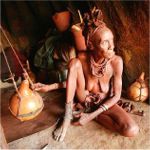
Woman and cooking pot
Over half of the population of Namibia belong to the Ovambo tribe, who occupy the northern part of the country. 

Other ethnic groups include the Kavango, Herero, Himba, Damara, Nama, Caprivian,  San (or Bushman), Baster and Tswana.  The Tswanas are the smallest ethnic group, with only 0.5% of the population. 
The minority white population are mostly of Afrikaan, German, British or Portuguese descent, and make up nearly 7% of the total population. 
Over 80% of the population are Christian, many of whom are Lutheran.   The remaining 20% follow indigenous religions. 
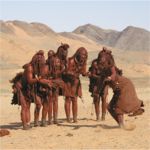
Himba dancing

Languages


English is the official language of Namibia, although it is only the first language of a small percentage of the population, about 7%.
Afrikaans is the most widely spoken first language for most Namibians, and around 30% of the population also speak German.
Different tribes throughout the country speak either a Bantu dialect (including Owambo, Caprivian and Herero) or a Khoisan dialect (including Nama, Damara and San).  The Khoisan dialects are characterised by a 'clicking' sound.
A few useful phrases to know in Afrikaans could be:
  • Good morning! - Goeie more!
  • How's it going? - Hoe gaan dit?
  • Great/Wonderful - Lekker
  • Please - Asseblief
  • Thanks - Dankie
  • Goodbye - Totsien


    Namibia is not a difficult place to travel in, and whilst there is a remoteness and space which it is hard to find elsewhere, the 2  biggest headaches for most travelers will be the vast distances and unforgiving desert heat.

    Much of Namibia is part of the great dry deserts of the Namib, which runs along the entire western coastline, and the Kalahari in the east.
    Clouds
    Contrasting with these huge deserts is the sub tropical rainforest area of the far north-east around the Caprivi Strip, and the inland plateau of central Namibia is characterized by mountains and rocky outcrops. 
    Because of these wide geographic variations, the climatic conditions differ immensely as you travel through Namibia. 

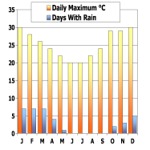
     Windhoek

    windhoek weather
    The central area around Windhoek is generally cooler, partly due to its elevation at just over 1,600m.
    The rainy season is January to March, and is accompanied by violent thunderstorms and heavy downpours.  Average Summer temperatures are around 30°C, but coupled with the high humidity levels Summer in the capital city can be almost unbearable. 
    The Winter months are more pleasant and comfortable.


Monday, April 30, 2012

Tentative Itinerary


June 29th/30th : Travel to Namibia.

July 1st : Settle in. Meet with missionaries we will be helping out. 

July 2nd : Travel from Windhoek to Sawkopmund on the coast. Set up and prepare for our first Holiday Club the next day. 

July 3rd/4th/5th : Holiday Club for about 400+ girls. 

July 6th : Visit to homes or Hospital. Prepare and set up for Women Of Value Lunch.

July 7th : Women of Value Luncheon. 

July 8th : Church with local missionaries. Prepare and set up for Holiday Club the next day. 

July 9th/10th/11th :  Holiday Club for 400+ boys. 

July 12th : day of rest. Game Drive. Shopping. 

July 13th/14th : Travel home.  

Garage Sale


 This Saturday is our BIG Garage Sale...
 2014 - 163rd St. SE, Mill Creek
"Wildflower."  
The closest main street is Seattle Hill Rd.
At Wildflower, her home is in the 1st cul de sac,
 3rd house on the right.  


Saturday, April 28, 2012

Namibia Wild Life


The ruggedness of the Namibian landscape has obviously done nothing to deter both flora and fauna from adapting and thriving. Here, the very act of survival can sometimes be an art. The shear abundance and variety of wildlife of all sizes is staggering.
Namibians are deeply committed to protecting our natural resources and the country’s richness of wildlife can be attributed in large part to this commitment to conservation. Namibians are committed to living side by side with wildlife, including predators and large mammals. Namibia is the only country in the world where large numbers of rare and endangered wildlife are translocated from national parks to open communal land. This commitment to protecting wildlife is especially important given the country’s remarkable diversity of species and high level of endemism. Namibia is home to approximately 4,350 species and subspecies of vascular plants, of which 17% are endemic. Six hundred and seventy-six bird species have been recorded, of which over 90 are endemic to Southern Africa and 13 to Namibia. Furthermore, 217 species of mammals are found in Namibia, 26 of which are endemic, including unique desert-dwelling rhino and elephants. This high level of endemism gives Namibia’s conservation of biodiversity a global significance.

No Better Words

Romans 12:9-18
Love must be sincere. Hate what is evil; cling to what is good. Be devoted to one another in brotherly love. Honor one another above yourselves. Never be lacking in zeal, but keep your spiritual fervor, serving the Lord. Be joyful in hope, patient in affliction, faithful in prayer. Share with God's people who are in need. Practice hospitality.Bless those who persecute you; bless and do not curse. Rejoice with those who rejoice; mourn with those who mourn. Live in harmony with one another. Do not be proud, but be willing to associate with people of low position. Do not be conceited.Do not repay anyone evil for evil. Be careful to do what is right in the eyes of everybody. If it is possible, as far as it depends on you, live at peace with everyone.

Better words could not be spoken before we leave for Namibia.
Read them and then Read them again each day before we go!!
Print them out on a sheet of paper and take them with you.
When fear of going seeks up on you,
read them and find God' peace.
When you feel worn out and tired,
read them and be reminded of what God calls us to be and do.
When you are not sure what to do,
read them and be remind what God would have you do.
When you are not sure how to handle a situation with someone else on the team, read them and know how God calls you to handle it.
When Dieing to Self seems impossible,
read them and see how God asks you to do it.
Follow these words and you will come home truly blessed!!

Wednesday, April 25, 2012

The What Ifs...


As we get closer to going thoughts start to come into your head:
The What if's:
What if I am not good at this?
What if I don't know what to do or say there?
What if Africa is really not safe?
What if I do or say something wrong?
What if I get sick?
What if... What if.... What if....
These questions are natural. 
This is my 7th trip to Africa and I still get the
What ifs.
The trick is to remember God is in control!!


Psalm 46: 1-7
God is our refuge and strength, an ever-present help in trouble.
Therefore we will not fear, though the earth give way
and the mountains fall into the heart of the sea,
though its waters roar and foam and the mountains quake with their surging.
There is a river whose streams make glad the city of God,
the holy place where the Most High dwells.
God is within her, she will not fall; God will help her at break of day.
Nations are in uproar, kingdoms fall; the lifts his voice, the earth melts.
The LORD Almighty is with us; the God of Jacob is our fortress.